
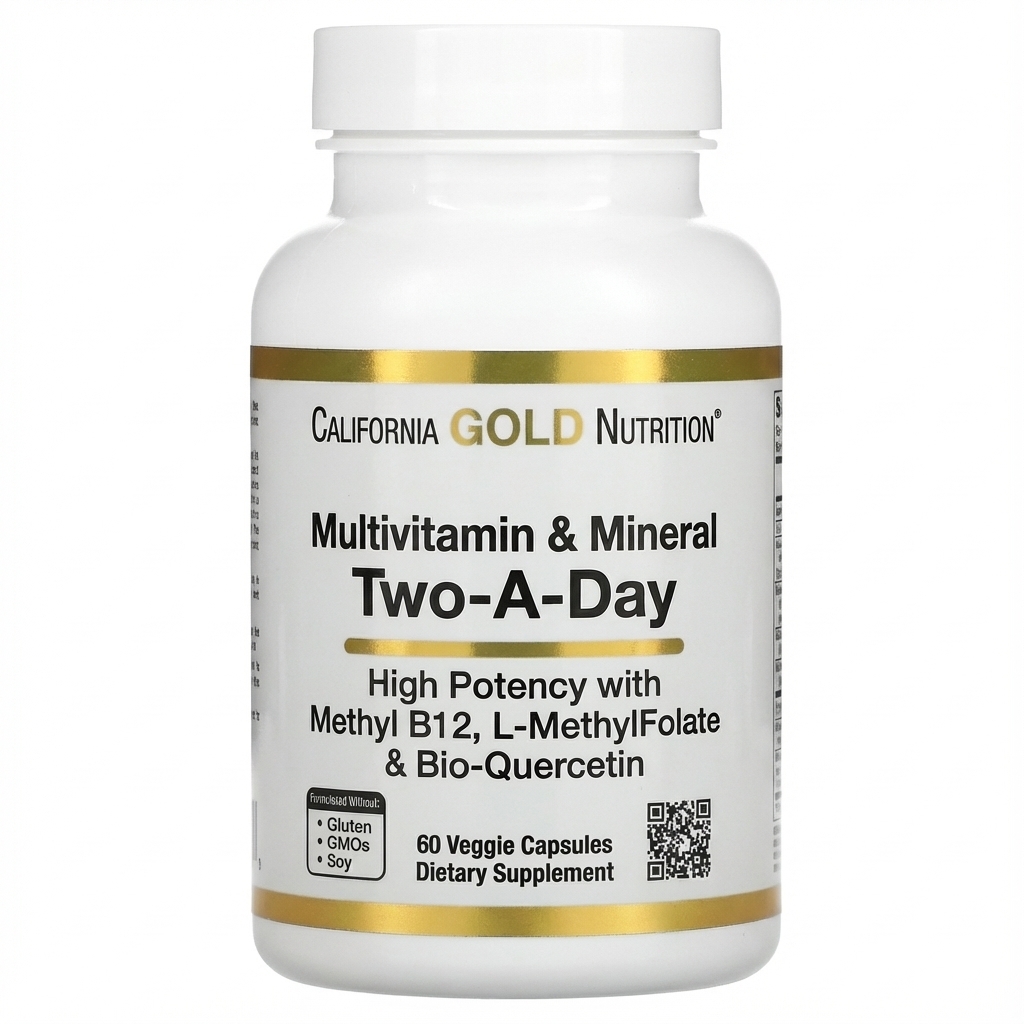
What this review covers
California Gold Nutrition Two-A-Day is a high-potency, two-capsule multivitamin built around active B-vitamin coenzymes, a partial chelated-mineral approach, and a small “add-on” antioxidant panel.
This page is a deep, product-only analysis focused on:
- Form quality (bioavailability and conversion steps)
- Dosage realism (does the dose match what research typically uses?)
- Execution risks (label clarity, mixed forms, “micro-dosed” extras)
Not medical advice. If you stack multiple supplements, the high-potency B-complex and minerals are where overdosing is most likely to happen.
Formula snapshot: the core idea
Serving format: 2 capsules per day, 30 servings per bottle.
The core architecture is clear:
- Active B stack (R5P, P5P, methyl-B12, L-5-MTHF) at high potencies
- Mineral “upgrade” focus on zinc + a few trace minerals, but magnesium remains mixed
- Antioxidant add-ons (lutein/zeaxanthin + quercetin phytosome + small polyphenols)
What’s missing (intentionally): this is not a “complete-mineral” multi. Magnesium is low vs daily needs, and there is no heavy mineral load (which improves tolerance but shifts the product into a vitamin-centric formula).
Active B-complex: the strongest part of the formula
This product’s best execution is the coenzyme-forward B-complex:
- Riboflavin 5''-Phosphate (R5P) — a directly usable B2 coenzyme form
- Pyridoxal-5-Phosphate (P5P) — active B6 form; less reliance on conversion
- Methylcobalamin (B12) — active form commonly used in supplements
The tradeoff: doses are very high (e.g., B6 at 75 mg/day). In practice, that can be “fine” for some users but becomes risky if you:
- stack additional B-complex / energy products, or
- use this daily long-term without a reason to run high B6.
Reality check: high-dose B6 is a common “performance” choice in multis, but it is also one of the most frequent cumulative-intake problem points. If you want a calmer daily multi, this may be more aggressive than necessary.
Methylfolate and MTHFR: benefit vs overhype
Two-A-Day uses L-5-MTHF (methylfolate), which is often marketed for people with MTHFR variants.
What’s actually useful here:
- L-5-MTHF is already an “active” folate form, so it reduces dependency on certain conversion steps.
What to avoid over-promising: having an MTHFR variant does not automatically mean you must avoid folic acid or that methylfolate is required for everyone. Many people can process folic acid just fine.
Practical take: methylfolate is a good quality signal in a multivitamin, but it should not be treated as a medical solution by itself.
Mineral strategy: chelates that matter
The mineral design is a mix of strong moves and compromises.
What stands out positively:
- Molybdenum glycinate chelate — fully chelated (high confidence delivery)
- Boron chelate — typically used as a chelated trace mineral form
- Zinc blend that includes zinc mono-L-methionine sulfate (often positioned as a higher-absorption form than basic salts)
Where it’s not “all-in”:
- Magnesium is not fully chelated (it’s a blend with oxide).
Takeaway: the trace-mineral choices suggest the formulator cared about absorption, but magnesium is where cost/space compromises show up.
The magnesium issue: oxide + bisglycinate at 105 mg
Magnesium is listed as 105 mg per serving from magnesium oxide + magnesium bisglycinate.
Why this matters:
- Magnesium oxide is widely considered a lower-absorption form.
- Magnesium bisglycinate is typically viewed as a better-absorbed / better-tolerated form.
The execution problem: the label does not disclose the split between oxide vs bisglycinate. So the “bysglycinate upgrade” can be:
- meaningful (if a large portion is bisglycinate), or
- mostly cosmetic (if oxide provides most of the elemental magnesium).
Dosage realism: 105 mg/day is not a standalone magnesium strategy for most adults. Treat it as a small baseline contribution, not a therapeutic magnesium dose.
Eye + antioxidant panel: what is meaningful vs micro-dosed
The antioxidant panel looks impressive on paper, but the key is dose relevance.
Eye support: the high-signal part
- Lutein 10 mg — this is a “real” dose level that aligns with common eye-formula targets.
- Zeaxanthin 550 mcg — present, but comparatively small next to typical eye-formula dosing.
Micro-dosed add-ons (low confidence for standalone effects)
- Inositol 50 mg — far below gram-level protocols used in clinical settings for specific conditions.
- Alpha lipoic acid 25 mg — far below doses commonly studied for neuropathy/metabolic outcomes.
- Apigenin 5 mg and lycopene 4 mg — could add “diet-like” antioxidant coverage, but do not expect strong clinical effects at these levels.
How micro-dosing affects synergy: these ingredients can still act as supporting context (broad antioxidant coverage), but they should not be used as primary reasons to buy the product.
Bio-Quercetin phytosome: better delivery, tiny dose
This formula includes quercetin phytosome (a phospholipid complex) at 15 mg.
What’s genuinely good here: phytosome delivery systems can improve absorption compared to standard quercetin.
The dose problem: the best-known human absorption comparisons typically use hundreds of milligrams of quercetin (or phytosome equivalents). At 15 mg, you’re getting a “presence dose,” not a therapeutic quercetin protocol.
Practical take: treat this as a quality marker (better form), not a primary efficacy driver.
Selenium sourcing: the SelenoExcell mismatch
This is the most important documentation red-flag on the iHerb listing.
Supplement Facts shows: “Selenium (as High Selenium Yeast)” — but does not name SelenoExcell® as the selenium source.
Yet the product listing also states: “Formulated with … SelenoExcell® Selenium.”
What this means in practice:
- You can’t confidently claim SelenoExcell® sourcing based on the Supplement Facts alone.
- This could be a legacy listing, a copy/paste carryover, or a formula revision not fully reflected across all listing fields.
How to handle it (consumer logic): trust the Supplement Facts panel first. If branded sourcing matters to you, confirm on the physical label and/or manufacturer documentation before treating it as a real differentiator.
Value and pricing: why it often costs more per day
Two-A-Day is frequently viewed as “the same blueprint” as other high-potency two-a-day multis. The pricing question is fair: why does it often cost more per serving?
The boring but real driver: this bottle has 30 servings (2 capsules/day). Many comparable “two-a-day” products ship as 120 tablets / 60 servings. If shelf prices are not dramatically different, cost per day will naturally look worse when the bottle has half the servings.
Secondary drivers (possible):
- Capsule format (veggie capsules) can be more expensive to manufacture than tablets.
- Licensed ingredients can add cost (e.g., methylfolate branding, quercetin delivery system claims).
Bottom line: the price premium is mostly a servings-per-bottle math issue, not a “twice as effective” issue.
If you are choosing between this and a similar two-a-day tablet multi, use the dedicated comparison page rather than repeating that decision tree here.
Who this multivitamin fits best
Best fit if you want:
- Active B forms (methyl-B12, L-5-MTHF, R5P, P5P) in a daily multi
- Trace-mineral quality signals (zinc methionine complex, chelated boron/molybdenum)
- Eye-support emphasis with a meaningful lutein dose
- Capsules instead of tablets
Think twice if you:
- already take a B-complex / energy stack (B6 accumulation is the common trap)
- want magnesium to do “real work” (the dose is low and the form is mixed)
- buy this mainly for quercetin/ALA/inositol effects (the doses are small)
Bottom line
California Gold Nutrition Two-A-Day is a high-potency, coenzyme-heavy multivitamin with a trace-mineral and antioxidant “upgrade” theme.
What it does well: active B-forms + a few smart mineral choices + a meaningful lutein dose.
What holds it back: mixed magnesium execution, multiple micro-dosed add-ons, and a documentation mismatch around branded selenium sourcing.
Decision rule: choose it for the B-complex + lutein core and capsule preference. Do not choose it expecting the small “extras” to function like standalone clinical doses.
Similar Multivitamins
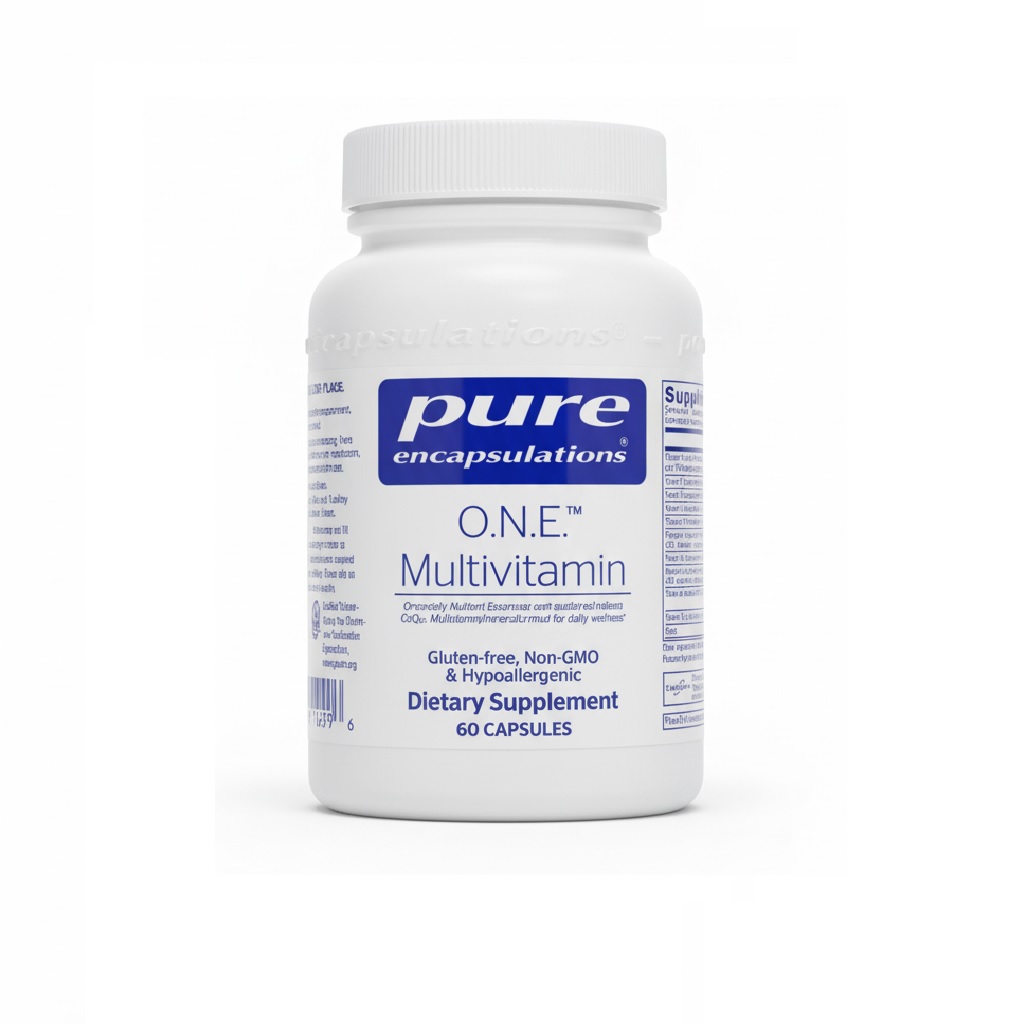
Pure Encapsulations, O.N.E.™ Multivitamin, 60 Capsules
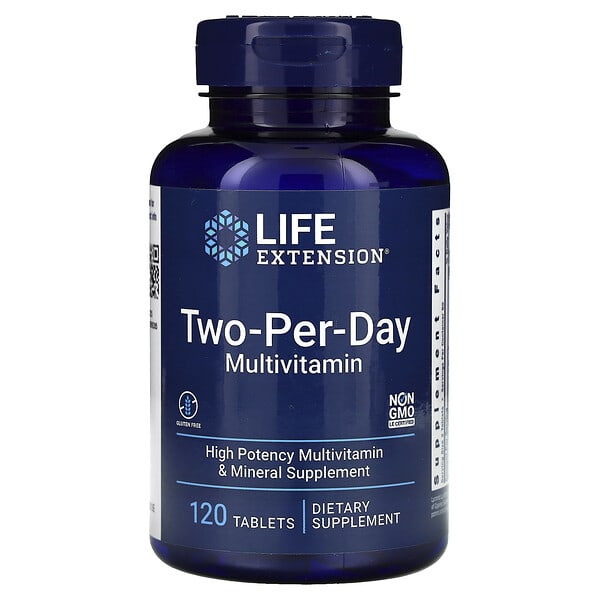
Life Extension, Two-Per-Day Multivitamin, 120 Tablets
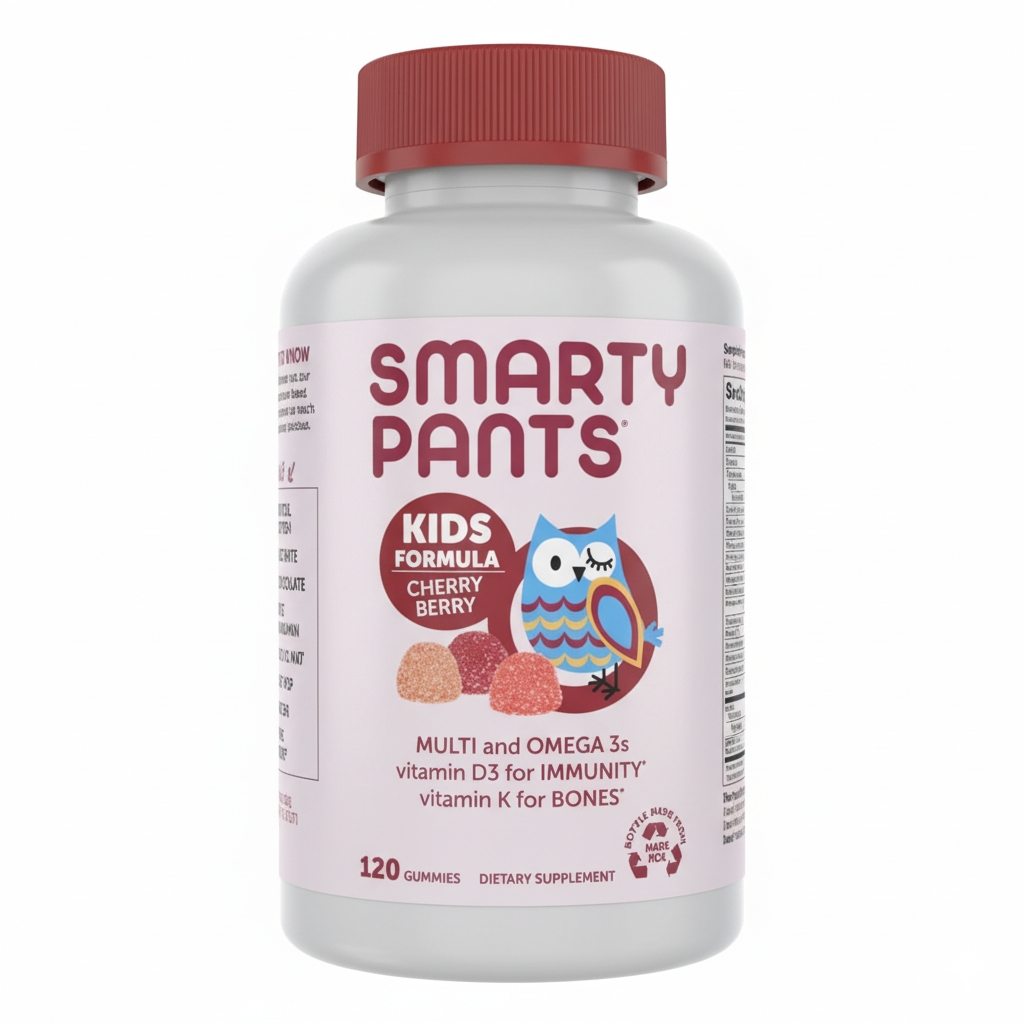
SmartyPants, Kids Formula, Multi and Omega 3s, Cherry Berry, 120 Gummies
IM8, Daily Ultimate Essentials Pro
Frequently Asked Questions
What is the serving size for California Gold Nutrition Two-A-Day?
The serving size is 2 capsules per day (Two-A-Day). That means a 60-capsule bottle provides 30 servings.
Does California Gold Two-A-Day contain methylfolate (5-MTHF)?
Yes. Folate is listed as Calcium L-5-Methyltetrahydrofolate (5-MTHF), which is an “active” folate form commonly chosen by users who prefer methylated B vitamins.
Is this multivitamin good for people with an MTHFR mutation?
It can be a reasonable option because it uses 5-MTHF instead of standard folic acid. However, methylfolate is not automatically required for everyone with MTHFR variants. Treat it as a quality preference, not a medical solution by itself.
Does Two-A-Day use active forms of B vitamins?
Yes. The formula includes methylcobalamin (B12) and also uses coenzyme-style forms such as riboflavin 5’-phosphate (B2) and pyridoxal 5’-phosphate (P5P, B6) alongside standard forms.
Is the vitamin B6 dose too high?
The product is high-potency and includes a large B6 dose. This is not automatically “bad,” but it becomes a problem if you stack multiple supplements (B-complex, energy formulas, pre-workouts). If you prefer conservative daily dosing, this formula may be more aggressive than necessary.
What kind of magnesium does it use: oxide or bisglycinate?
It uses a blend: magnesium oxide + magnesium bisglycinate, totaling 105 mg per serving. The label does not disclose how much comes from each form, so the real “bisglycinate advantage” can’t be quantified from the Supplement Facts alone.
Is 105 mg magnesium enough to feel an effect?
For most adults, 105 mg/day is a modest amount and usually not a standalone magnesium strategy. Consider it a baseline contribution from a multivitamin, not a therapeutic magnesium dose.
Does Two-A-Day include chelated minerals?
Yes, but it’s a mixed mineral strategy. The trace minerals are the cleanest story (e.g., boron chelate and molybdenum glycinate chelate), while magnesium remains partially compromised due to the oxide blend.
Does it contain iron?
No. Iron is not listed on the Supplement Facts panel, so this is an iron-free multivitamin. That can be a plus for people who don’t want routine iron supplementation.
Is the lutein and zeaxanthin dose meaningful?
Lutein (10 mg) is a meaningful “eye panel” dose level. Zeaxanthin (0.55 mg) is present but comparatively light versus dedicated eye formulas. If eye support is your main goal, this is a solid lutein-forward baseline, not a full AREDS2 replacement.
Is the quercetin phytosome dose effective?
It uses a higher-absorption format (quercetin phytosome), but the dose (15 mg) is small compared to the amounts typically used in standalone quercetin supplementation. Treat it as a supportive add-on, not a primary quercetin protocol.
Does it really contain SelenoExcell® selenium?
The product description may mention SelenoExcell®, but the Supplement Facts panel lists selenium only as “High Selenium Yeast” without confirming the branded source. For accuracy, trust the Supplement Facts panel first and treat branded selenium claims as not verified on-label unless the physical label confirms it.
Sources
- iHerb — California Gold Nutrition Two-A-Day (Product Page)
- iHerb — Life Extension Two-Per-Day Multivitamin, 120 Tablets (Product Page)
- National Eye Institute (NIH) — About AREDS and AREDS2 (Lutein 10 mg + Zeaxanthin 2 mg arm)
- CDC — MTHFR Gene Variant and Folic Acid Facts
- CDC — Folic Acid: Facts for Clinicians (Clinical Overview)
- NIH Office of Dietary Supplements — Selenium: Health Professional Fact Sheet
- EFSA Journal (2023) — Scientific Opinion on the Tolerable Upper Intake Level for Vitamin B6
- PubMed — Magnesium bioavailability from magnesium citrate and magnesium oxide (solubility comparison)
- PubMed — Assessment of bioavailability of Mg from Mg citrate and Mg oxide (urinary excretion endpoint)
- PMC — Improved Oral Absorption of Quercetin from Quercetin Phytosome (Riva et al., 2018)
- WebMD — Alpha-Lipoic Acid: Uses, Side Effects, and More
- Journal of Clinical Endocrinology & Metabolism (2024) — Inositol for PCOS: Systematic Review and Meta-analysis
Disclaimer
The information provided on this website is for informational purposes only and is not intended as medical advice, diagnosis, or treatment. Always consult with a healthcare professional for any health-related questions or concerns.